



















Planning a summer of riding in Spain means choosing a bike that copes with heat, long distances and a mix of surfaces on the same trip. A morning commute through the city can turn into an afternoon on a coastal road and a weekend stretched across open country, and few conventional bikes handle all three comfortably.
This is where Bici Eléctrica Trekking earns its place. Built for endurance rather than sprints, a trekking e-bike carries you further with less fatigue, holds a steady pace on hills, and keeps its composure when the tarmac gives way to gravel.
Since 2024 the Fiido’s have run an assembly plant in France, doing final assembly, inspection, and road testing before a bike ships out.
That local piece matters for compliance too. EU rules on things like battery transport and regional traffic regulations shift fairly often, and being on the ground means Fiido can adjust faster than if it were waiting on a factory overseas. Quality checks happening in Europe instead of after a long ocean crossing usually means faster delivery and fewer surprises on build quality. Which means that the final check before a bike goes out the door now happens a lot closer to whoever’s about to ride it For riders in Madrid and across the Región de Murcia, the appeal is practical. The days are long, the routes are varied, and the reward for a capable machine is more ground covered and less time worrying about range. The five models below were assessed against the kind of riding a Spanish summer actually throws at you.
Spain’s geography makes a strong case for trekking e-bikes. Inland cities like Madrid sit on high, rolling terrain, while Murcia pairs city streets with coastal roads and dry, mixed-surface tracks heading out towards the huerta. A Bici Eléctrica Trekking is designed for exactly this blend, giving you an upright, comfortable position for hours in the saddle and enough assistance to flatten the climbs without draining the battery before you are home.
Heat is the other factor. Riding at 35 degrees changes how you think about effort, and pedal assistance lets you keep moving without overheating on the steeper sections. The best touring models pair a responsive torque sensor with a large, often expandable battery, so a long weekend route stays well within reach rather than becoming a gamble.
A few qualities matter more than the rest when riding through a Spanish summer:
• Comfort geometry and suspension that absorb rough coastal and rural surfaces.
• Real-world range that covers long routes between charges, ideally with an expandable battery.
• Smooth torque-sensor assistance that responds to effort rather than switching on abruptly.
• Practical touring fittings such as racks, mudguards and lights for mixed urban and outdoor use.
We put each bike through the same summer routine rather than a single lab benchmark. Mornings meant the stop-start grind through town, threading traffic and hopping kerbs. Middays were spent out on the exposed roads where the heat sits heavy and the assistance earns its keep on the climbs.
Weekends were the real test, longer routes out towards the coast and the huerta on a mix of tarmac, hard-pack and loose gravel. What we cared about was how each bike felt after two or three hours in 34-degree heat, not how it reads on a spec sheet.
Rating ★★★★★
The Nomads was the bike we kept reaching for. It is a genuine Bici Eléctrica Trekking, and over a fortnight of mixed riding it never once felt out of its depth. The torque sensor is the star of it. On a stiff climb out of town the assistance came on in proportion to how hard we pushed, so there was none of the sudden surge that unsettles you mid-corner.
The 29-inch wheels and hydraulic brakes made short work of a rutted gravel track down towards the coast, where a smaller-wheeled bike would have skittered around. Range is where it won us over for the longer weekends.
A single battery comfortably covered a full day of riding with pedal assist to spare, and clipping in the extra batteries from Fiido’s three-battery setup took a planned coastal loop past 200 km without a charging stop. In practice that meant leaving the spare pack at home for the commute and only carrying it when the route demanded it, all on the same frame.
The other thing worth saying is how it wears its price. Sitting at a set of traffic lights, it looks like a bike that should cost considerably more, and Fiido has built a solid reputation across Germany and the wider European market on exactly that value equation.
Pros
• Excellent price-to-performance for a true touring build.
• Expandable battery system for genuinely long weekend routes.
• Comfortable geometry that works for both commuting and touring.
• Torque-sensor assistance that feels smooth and intuitive.
Cons
• Extra batteries add to the cost for maximum range.
• Not the lightest option once fully equipped for touring.
Rating ★★★★☆
If your idea of a summer weekend is setting off after breakfast and not thinking about a plug all day, the Titan is the one. We took it on the longest route of the test, a full day tracing inland roads and looping back along the coast, and never dropped below half a battery.
Its three-battery arrangement is built for real-world range close to 347 km, and out on those open stretches the range anxiety simply evaporated. You stop worrying about the charge and start planning by daylight instead.
The price you pay is felt the moment you lift it. This is a heavy bike, and back in town it was noticeably less willing to duck through traffic or hop up onto a pavement than the Nomads. On a fast descent it stays planted and reassuring, but wheeling it up a flight of steps to a flat is a chore. It is more machine than a pure commuter needs, and it knows it.
Pros
• Class-leading range for multi-day and all-day touring.
• Stable and composed on long, open routes.
Cons
• Heavier and less agile in city traffic.
• Range beyond what many everyday riders will use.
Rating ★★★★☆
The Verve+ 2 was the bike everyone found easiest to get on and ride. The upright position keeps your eyes up in traffic, and on the rolling streets around the city centre it felt planted and unfussy from the first pedal stroke. On the hottest morning of the test it was the one we picked for the commute, purely because it asks so little of the rider. The assistance is gentle and consistent, which is exactly what you want when you are trying not to arrive at work drenched.
Push it beyond the city and the limits show. On a longer gravel section out past the edge of town it managed, but it was clearly happier back on tarmac, and its range fell short of the expandable-battery tourers on our longest loop. For a rider whose weekends stay close to home, that is a compromise worth making. For one planning to disappear into the countryside for a day, less so.
Pros
• Comfortable, confidence-inspiring commuter geometry.
• Reliable components and strong dealer support network.
Cons
• Range trails the expandable-battery touring models.
• Less suited to sustained off-road riding.
Rating ★★★★☆
The Cube feels like a proper touring bike in the old European sense, just with a motor tucked into it.
Everything is where a seasoned tourer expects it, the rack, the mudguards, the integrated lights, and nothing rattled loose over a rough afternoon of mixed surfaces.
The Bosch mid-drive is the quietest, most even assistance in the group. On a long, steady climb it simply held our pace without ever calling attention to itself, which after two hours in the sun is a real virtue.
What gives us pause is the value. It is a polished, hard-wearing bike that will likely still be going strong in a decade, but on our longest route it covered similar ground to bikes costing noticeably less. Riders who want refinement above all will happily pay for it. Those counting kilometres per euro will look elsewhere.
Pros
• Complete touring specification straight from the shop.
• Refined Bosch mid-drive assistance.
Cons
• Higher price for comparable real-world range.
• Less flexible battery expansion than rivals.
Rating ★★★★☆
The Optima was the bike we enjoyed most in the tight stuff. It is the lightest here by a clear margin, and that showed the moment we hit a busy street, flicking between gaps and rolling away from the lights with an ease the heavier tourers could not match. Carrying it up to a third-floor flat at the end of a ride was almost pleasant, which is not something you say about most e-bikes. The assistance is subtle and natural, closer to a good analogue bike with a helping hand than a motor doing the work for you.
That lightness has a cost, and it is expensive. On a longer countryside loop it needed managing where the expandable-battery bikes just kept going. Treat it as a brilliant city bike that happens to be very good for a shorter weekend escape and it makes complete sense. Ask it to cross Murcia and back in a day and you will be watching the battery.
Pros
• Light and agile for city handling and storage.
• Clean design with smooth, natural assistance.
Cons
• Shorter range than dedicated long-distance tourers.
• Best kept for lighter off-road use.
The table below sets the five models side by side across the factors that matter most for a Spanish summer of riding. Figures reflect manufacturer claims and published reviews, and real-world range will vary with terrain, rider weight and assistance level.
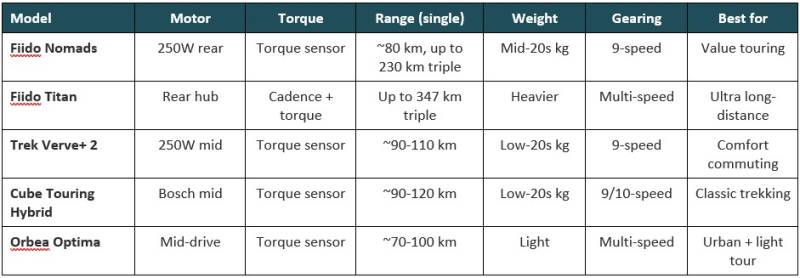
After two weeks of swapping between them, the pattern was clear. If your riding stays mostly in town with the odd weekend spin, the lighter Optima or the easygoing Verve+ 2 will make you happy. If you are chasing the longest routes or planning to be out all day, range and an expandable battery matter more than anything, and that points at the Titan for outright distance or the Cube for classic touring polish.
But the bike that handled every one of our test days without complaint, from the sweaty morning commute to the long coastal loop, was the Fiido Nomads. It commuted without fuss, toured without hesitation, and stretched its range to meet whatever the day asked, all while leaving money in the bank for the kilometres ahead.
A Spanish summer asks for a lot from a bike. It has to survive the heat, shrug off a rutted track, hold a pace up a long climb and still be pleasant to ride home on tired legs. Every model here earned its place, from the Titan’s endless range to the Optima’s lightness in traffic, but the one we would put our own money on for 2026 is the Fiido Nomads.
Across every test day it did the whole job, and it did it for a price that still surprises us, which makes it the bike to beat for daily commuting, summer touring and long leisure rides alike. For riders in Madrid, Murcia and beyond who want one bike to carry them through the whole season, it is the natural place to start.